


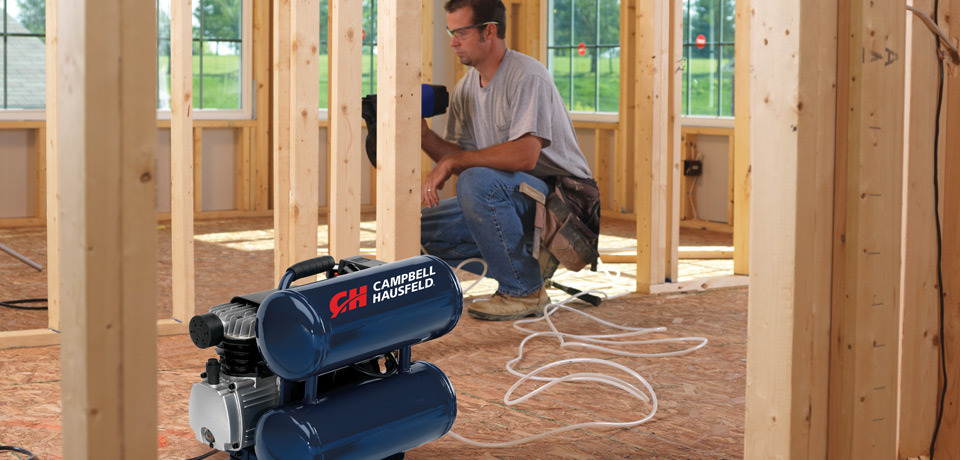
The tool industry is usually quick to talk about the latest power or carpentry tools, but less attention is given to what powers these tools. That’s why we will be looking into what you need to know about air compressors and generators, as they play such a crucial role on the jobsite.
Air Compressors
Air power is a timeless form of technology that the modern world still relies upon. Campbell Hausfeld specializes in this technology, offering a variety of air compressors designed for contractor use. There are a few key attributes, however, that a contractor or anyone else should consider before committing to a purchase.
Portability
The tank design can either help or hinder a project. For a person on the jobsite, a portable, easy-to-carry compressor will make a huge difference. Look for configurations such as twin-stack, pancake, horizontal or wheelbarrow. All of these units can be either carried or wheeled out to a project. If much power is required for your worksite, you may want to consider a truck-mounted unit. These larger units are typically equipped with powerful engines and come available in both gas and electric varieties.
Tank size
Bigger is not always better. A professional contractor needs a fuel tank large enough to power the job’s air tools, but not so big that the unit cannot be moved around on the site. Check your air tools to make sure your compressor selection can handle the CFM (volume of air delivered to the air tool) required. This information can usually be found on the manufacturer’s website or in the manual.
Pump
There are two basic types of pumps to consider: oil-lubed and oil-free. Oil-lubed pumps can extend pump life by keeping the pump cooler and reducing wear on the unit. These pumps do require more maintenance, as oil will need to be added and cleaned. Oil-free pumps rely on self-lubricating materials to allow the piston to slide in the cylinder and grease the sealed bearings. These units are maintenance-free but generally have slightly shorter lifespans than their an oil-lubed counterparts.
Motor
The horsepower (HP) of a compressor’s motor is an important factor to consider. The motor supplies power to the pump, which delivers the compressed air to the tank. The higher the HP, the less recovery time for the unit.
Some Campbell Hausfeld compressors recommended for jobsites include these: the CT4361, a 4.5-gallon, twin-stack air compressor; the HL5402, a four-gallon, twin-stack air compressor; and the VT6290, a 20-gallon horizontal air compressor.
Generators
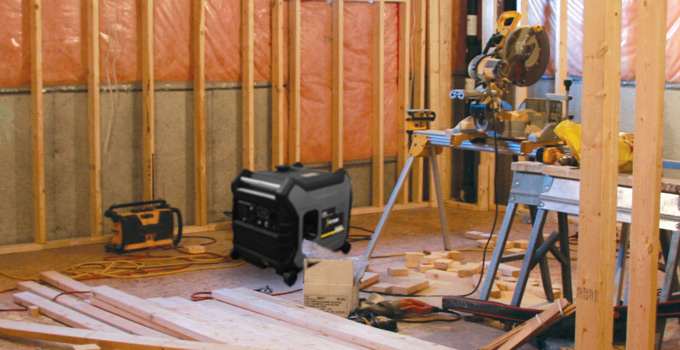
Conventional generators are common sights to contractors – they power lighting and equipment in places where electrical services aren’t wired yet. They’re also known for their portability, run-time and power output. Generator/inverters (commonly referred to as simply “inverters”) are a more recent phenomena on the jobsite. Like conventional generators, they supply AC power, allowing the running of a variety of devices and tools. But unlike conventional generators, they first convert the AC current they produce to DC. Before outputting the power again as AC, this three-phase process improves the quality of the power that is produced, ensuring tools and devices operate more efficiently.
Another benefit with inverters is their portability. Because they are usually lighter and smaller than conventional generators, they are easier to move around the site and to different jobs. They also produce significantly less noise, which can be a benefit when working on projects where the client is on-site. Inverters often use smaller, more efficient engines, which translating to better fuel efficiency.
Conventional generators do have their own perks, however, including an increased maximum run-time and power output because of their generally larger size than inverters. This size difference allows for bigger engines and fuel tanks. Additionally, they often cost less than inverters. So careful consideration should be given to one’s needs on the jobsite before coming to a decision as to which is best.
Regardless of your choice, Co-op recommends BE’s Xstream line of generators and inverters. Xstream’s heavy-duty lineup of generators includes units powered by Honda engines, and they offer inverters with electric start and parallel capability to meet the needs of any jobsite.